Jab we Met
Jab we Met
Yep, how did we even decide to do this.
Yep, how did we even decide to do this.
01 Origins: our Eureka moment.
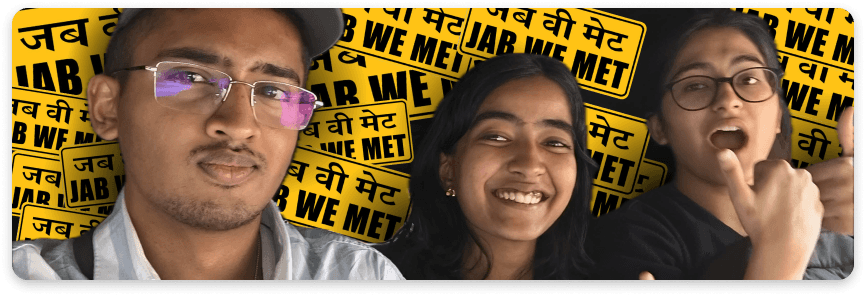
A gnome, a hyperactive kid and a student that texts like a dad walk into a bar. That’s roughly how TIDEx began- minus the bar, just a whole lot of Google Meets.
But that’s still way too far ahead. Let us tell you from the start how we began.
In our first semester, we were sent onto the streets of beautiful, bustling Mumbai to research design from the grassroots level. The brief was simple enough: observe, interact, engage. Locate a problem right in those streets, spend five weeks researching it, and then another five weeks designing a solution for it. Toolkits, tally marks and tailing some very confused Mumbaikars- we’d seen and done it all.
And yet.
Here we were, with prototypes and proposed solutions in hand, when we were told- “This won’t be implemented.” Hold up- what?
Us: “You mean… we did all this work, and it’s not going to be used?”
Faculty: “The point was to understand the process, not necessarily create a final product.”
Us: “But how will we know if it actually worked?”
Faculty: “Ask your users if they would use it.”
Us: “…Would?”
Clearly, “would" wasn't good enough for us.
01 Origins:
our Eureka moment.
A gnome, a hyperactive kid and a student that texts like a dad walk into a bar. That’s roughly how TIDEx began- minus the bar, just a whole lot of Google Meets.
But that’s still way too far ahead. Let us tell you from the start how we began.
In our first semester, we were sent onto the streets of beautiful, bustling Mumbai to research design from the grassroots level. The brief was simple enough: observe, interact, engage. Locate a problem right in those streets, spend five weeks researching it, and then another five weeks designing a solution for it. Toolkits, tally marks and tailing some very confused Mumbaikars- we’d seen and done it all.
And yet.
Here we were, with prototypes and proposed solutions in hand, when we were told- “This won’t be implemented.” Hold up- what?
Us: “You mean… we did all this work, and it’s not going to be used?”
Faculty: “The point was to understand the process, not necessarily create a final product.”
Us: “But how will we know if it actually worked?”
Faculty: “Ask your users if they would use it.”
Us: “…Would?”
Clearly, “would" wasn't good enough for us.
01 Origins: our Eureka moment.
A gnome, a hyperactive kid and a student that texts like a dad walk into a bar. That’s roughly how TIDEx began- minus the bar, just a whole lot of Google Meets.
But that’s still way too far ahead. Let us tell you from the start how we began.
In our first semester, we were sent onto the streets of beautiful, bustling Mumbai to research design from the grassroots level. The brief was simple enough: observe, interact, engage. Locate a problem right in those streets, spend five weeks researching it, and then another five weeks designing a solution for it. Toolkits, tally marks and tailing some very confused Mumbaikars- we’d seen and done it all.
And yet.
Here we were, with prototypes and proposed solutions in hand, when we were told- “This won’t be implemented.” Hold up- what?
Us: “You mean… we did all this work, and it’s not going to be used?”
Faculty: “The point was to understand the process, not necessarily create a final product.”
Us: “But how will we know if it actually worked?”
Faculty: “Ask your users if they would use it.”
Us: “…Would?”
Clearly, “would" wasn't good enough for us.
Though each of us did this project with very different people, we were brought together by the common need to create designs AND see them implemented. We didn’t want design to stop at the hypothetical. We wanted to know, more than anything, how we could create work that actually mattered. We wanted, nay, we needed to see the impact of research and design.
Moreover, this project made us realise where design can exist where we had no idea that it could. That it wasn’t just about high-end technology and glitzy advertising. We worked with kirana stores, chai vendors and (sam’s project), not magazines and fashion brands. Design existed here too, in areas where beauty and aesthetics were highly irrelevant. It sparked the question: What does design look like when stripped of its glamour? When it was needed on the backend, to turn gears and make systems operate?
Enter Sam stage left.
He approached Riddhi and I with a simple proposition- Let’s create a team that brings design to all these areas where it has not existed before. One that has passion, creativity and just enough audacity to approach companies in India and tell them why they needed our ideas on their team. We wanted to see our research and creations actually play out in front of us- to see them used, worked and lived with. So why not start a company for it?
And obviously, we said yes.
In the marathon of Google Meets that followed, we made some very important, very adult decisions. What was our vision? Who did we want to work with? How can we get Sam to download Instagram so he understands our references? We clearly had our priorities straight.
Research, as we’d learnt, is no good when it’s limited to just design. Rather, it should involve psychology, medicine, engineering, all that good stuff. So what if, instead of bringing all these fields to design, we did the opposite? We brought design to them?
We didn’t think design should be limited to the way a solution is packaged and presented. Through research into other fields, we wanted to apply the designer’s lens to the systems and operations running a company. Our research helps us understand the details of the problem, our creativity helps us in finding a solution for it. There- that was our funda.
And what would we call this beautiful, bold adventure of ours?
An experiment. A new ground, rooted in India, for three first-years to test an idea that had hatched in a Google Meet and refused to go away.
With love, we bring to you, The Indian Design Experiment.
Our friends call us TIDEx.
Though each of us did this project with very different people, we were brought together by the common need to create designs AND see them implemented. We didn’t want design to stop at the hypothetical. We wanted to know, more than anything, how we could create work that actually mattered. We wanted, nay, we needed to see the impact of research and design.
Moreover, this project made us realise where design can exist where we had no idea that it could. That it wasn’t just about high-end technology and glitzy advertising. We worked with kirana stores, chai vendors and (sam’s project), not magazines and fashion brands. Design existed here too, in areas where beauty and aesthetics were highly irrelevant. It sparked the question: What does design look like when stripped of its glamour? When it was needed on the backend, to turn gears and make systems operate?
Enter Sam stage left.
He approached Riddhi and I with a simple proposition- Let’s create a team that brings design to all these areas where it has not existed before. One that has passion, creativity and just enough audacity to approach companies in India and tell them why they needed our ideas on their team. We wanted to see our research and creations actually play out in front of us- to see them used, worked and lived with. So why not start a company for it?
And obviously, we said yes.
In the marathon of Google Meets that followed, we made some very important, very adult decisions. What was our vision? Who did we want to work with? How can we get Sam to download Instagram so he understands our references? We clearly had our priorities straight.
Research, as we’d learnt, is no good when it’s limited to just design. Rather, it should involve psychology, medicine, engineering, all that good stuff. So what if, instead of bringing all these fields to design, we did the opposite? We brought design to them?
We didn’t think design should be limited to the way a solution is packaged and presented. Through research into other fields, we wanted to apply the designer’s lens to the systems and operations running a company. Our research helps us understand the details of the problem, our creativity helps us in finding a solution for it. There- that was our funda.
And what would we call this beautiful, bold adventure of ours?
An experiment. A new ground, rooted in India, for three first-years to test an idea that had hatched in a Google Meet and refused to go away.
With love, we bring to you, The Indian Design Experiment.
Our friends call us TIDEx.
Though each of us did this project with very different people, we were brought together by the common need to create designs AND see them implemented. We didn’t want design to stop at the hypothetical. We wanted to know, more than anything, how we could create work that actually mattered. We wanted, nay, we needed to see the impact of research and design.
Moreover, this project made us realise where design can exist where we had no idea that it could. That it wasn’t just about high-end technology and glitzy advertising. We worked with kirana stores, chai vendors and (sam’s project), not magazines and fashion brands. Design existed here too, in areas where beauty and aesthetics were highly irrelevant. It sparked the question: What does design look like when stripped of its glamour? When it was needed on the backend, to turn gears and make systems operate?
Enter Sam stage left.
He approached Riddhi and I with a simple proposition- Let’s create a team that brings design to all these areas where it has not existed before. One that has passion, creativity and just enough audacity to approach companies in India and tell them why they needed our ideas on their team. We wanted to see our research and creations actually play out in front of us- to see them used, worked and lived with. So why not start a company for it?
And obviously, we said yes.
In the marathon of Google Meets that followed, we made some very important, very adult decisions. What was our vision? Who did we want to work with? How can we get Sam to download Instagram so he understands our references? We clearly had our priorities straight.
Research, as we’d learnt, is no good when it’s limited to just design. Rather, it should involve psychology, medicine, engineering, all that good stuff. So what if, instead of bringing all these fields to design, we did the opposite? We brought design to them?
We didn’t think design should be limited to the way a solution is packaged and presented. Through research into other fields, we wanted to apply the designer’s lens to the systems and operations running a company. Our research helps us understand the details of the problem, our creativity helps us in finding a solution for it. There- that was our funda.
And what would we call this beautiful, bold adventure of ours?
An experiment. A new ground, rooted in India, for three first-years to test an idea that had hatched in a Google Meet and refused to go away.
With love, we bring to you, The Indian Design Experiment.
Our friends call us TIDEx.
TL;DR: We started TIDEx to answer a simple question that burned within us: what if?
What if we took every norm a design studio follows, packed it in a box and sent it off far away?
What if instead, we answered all the questions design has never answered before, and started a firm along the way?
What if we thought of design like science? Like an experiment?
Eureka.
As a scientist, one has a certain set of principles: you observe, iterate, and hypothesize.
We are no different. We approach the world as a laboratory—each brief is a hypothesis, each prototype a question mark- each designed solution a bold, fresh experiment.
They say curiosity killed the cat; we say it gave us the idea for a company.
At TIDEx, we aren’t in the business of answers, of going down well-walked paths.
We’re in the business of discovery.
TL;DR: We started TIDEx to answer a simple question that burned within us: what if?
What if we took every norm a design studio follows, packed it in a box and sent it off far away?
What if instead, we answered all the questions design has never answered before, and started a firm along the way?
What if we thought of design like science? Like an experiment?
Eureka.
As a scientist, one has a certain set of principles: you observe, iterate, and hypothesize.
We are no different. We approach the world as a laboratory—each brief is a hypothesis, each prototype a question mark- each designed solution a bold, fresh experiment.
They say curiosity killed the cat; we say it gave us the idea for a company.
At TIDEx, we aren’t in the business of answers, of going down well-walked paths.
We’re in the business of discovery.
TL;DR: We started TIDEx to answer a simple question that burned within us: what if?
What if we took every norm a design studio follows, packed it in a box and sent it off far away?
What if instead, we answered all the questions design has never answered before, and started a firm along the way?
What if we thought of design like science? Like an experiment?
Eureka.
As a scientist, one has a certain set of principles: you observe, iterate, and hypothesize.
We are no different. We approach the world as a laboratory—each brief is a hypothesis, each prototype a question mark- each designed solution a bold, fresh experiment.
They say curiosity killed the cat; we say it gave us the idea for a company.
At TIDEx, we aren’t in the business of answers, of going down well-walked paths.
We’re in the business of discovery.
Designing with care, clarity, and purpose— to create soulful, enduring, and meaningful experiences.
Designing with care, clarity, and purpose— to create soulful, enduring, and meaningful experiences.